
Classic Albums - Lean Into It - Guitar Course
Complete Album Lessons with Sam Bell
Guitar Lessons In The Course

Classic Albums - Lean Into It

Song Lessons in this Course
Song-by-Song Guitar Lessons Taught by Sam Bell
Our Lean Into It guitar lesson course provides a meticulous, track-by-track breakdown of every song on the album. You will learn to play:
• Daddy, Brother, Lover, Little Boy (The Electric Drill Song): Master the iconic drill solo technique, blistering alternate picking, and intricate rhythmic figures.
• Alive and Kickin': Explore dynamic riffing, expressive bends, and Paul Gilbert's signature melodic soloing.
• Green-Tinted Sixties Mind: Unravel the sophisticated clean arpeggios, tasteful lead lines, and pop-infused chord voicings.
• CDFF – Lucky This Time: Learn tight, percussive rhythm guitar and fluid legato phrases.
• Voodoo Kiss: Delve into blues-rock swagger, powerful bends, and aggressive, yet musical, soloing.
• Never Say Never: Develop your right-hand control with rapid alternate picking and melodic phrasing that builds tension and release.
• Just Take My Heart: Discover the art of melodic ballad playing, subtle vibrato, and emotionally resonant lead work.
• My Kinda Woman: Tackle high-energy rhythm guitar, intricate fills, and explosive, technically demanding solos.
• A Little Too Loose: Embrace blues-infused rock, expressive slides, and a masterclass in tasteful phrasing.
• Road to Ruin: Learn powerful chord progressions, octave melodies, and harmonised guitar lines.
• To Be With You: Master the acoustic nuances, delicate strumming, and understated yet impactful solo that made this a global hit.
Each Mr. Big guitar lesson is designed to dissect Paul Gilbert's unique approach, providing you with the tools to reproduce his parts accurately and understand the musical theory behind them.
This Course is Ideal for Players Who...
This Mr. Big guitar lessons course is perfectly suited for:
• Intermediate to Advanced Guitarists: Players looking to push their technical boundaries and explore sophisticated rock guitar.
• Fans of Paul Gilbert and Mr. Big: Those eager to learn the exact guitar parts from Lean Into It and emulate a guitar legend.
• Aspiring Shredders: Guitarists who want to develop speed, precision, and clean articulation without sacrificing musicality.
• Rock Guitar Enthusiasts: Anyone seeking to expand their repertoire with classic 90s rock guitar lessons and understand the nuances of a pivotal album.
• Musicians Focused on Detail: Players who appreciate in-depth analysis of tone, phrasing, and song structure.
If you're ready to elevate your playing and immerse yourself in a masterclass of rock guitar, this course offers the definitive guitar lessons experience for Lean Into It.
What will I achieve from completing this course?
Upon completing this Lean Into It guitar lesson course, you will:
• Master Advanced Techniques: Significantly improve your alternate picking, legato, tapping, sweep picking, and vibrato, essential for any aspiring rock guitarist.
• Enhance Musicality: Develop a deeper understanding of melody construction, phrasing, and how to integrate technical prowess with expressive playing.
• Build a Repertoire: Command a full album's worth of iconic 90s rock guitar material, ready to play with confidence.
• Understand Paul Gilbert's Style: Gain unique insights into the creative mind and technical execution of one of rock's most influential guitarists.
• Improve Rhythm and Timing: Hone your rhythmic precision and ability to lock into complex grooves, a hallmark of Mr. Big's sound.
• Boost Your Confidence: Tackle challenging songs and emerge with a newfound sense of accomplishment and a significantly elevated skill set.
WE CAN HELP...
1-ON-1 COACHING
Access to thousands of lessons is great, but without a plan you can feel like you’re practicing in circles. Book your FREE 1-on-1 video call with a Licklibrary pro to fix your technique, build a practice plan, get motivated, or overcome any challenge. It's all included in your membership!
** Disclaimer **
*This product is not endorsed by or made in association with
Mr Big
nor does
Mr Big
perform or appear on this course.*
Lean Into It – Mr. Big
Released in 1991, Lean Into It stands as a landmark of melodic hard rock and precision guitar craft. To most listeners it’s remembered for the radio hit “To Be With You”, but to guitarists it’s a showcase of Paul Gilbert’s peak musicianship: a blend of raw speed, expressive phrasing, and tasteful restraint. It’s the kind of record that rewards both shredders and song-first players — every riff and solo brims with intent, melody, and musical humour.
Where Gilbert’s earlier work with Racer X was pure technical fire, Lean Into It is refinement. Every run, harmonic, and bend feels like part of a larger composition. There’s still the pyrotechnics — blistering alternate-picking lines, jaw-dropping tapped harmonics, and moments of two-handed insanity — but each is placed within the architecture of the song. The result is an album that perfectly marries virtuosity and songwriting. Sam Bell breaks down this classic album in this exclusive Lick Library video course.
Paul Gilbert’s Role and Tone Philosophy
Paul Gilbert’s contribution to Lean Into It is impossible to overstate. His playing defines the record’s identity — yet he never overshadows the vocals or the rest of the band. His rhythm parts are tight and articulate, locking seamlessly with Billy Sheehan’s bass, while his solos push expression over excess.
Tone-wise, Gilbert refined his signal path for this era: a high-gain yet transparent distortion that let every note pop. You can hear the pick attack clearly, even in full-chord crunch. Lead tones have just enough compression for sustain but retain dynamic control. He often doubled rhythm parts using different pickup positions to widen the stereo field — a masterclass in rock production.
The best part, though, is Gilbert’s musical empathy. His solos interact with Eric Martin’s vocal phrasing and Sheehan’s counter-melodies, making the guitar feel like a second singer rather than a competing voice. For advanced players, Lean Into It is a study in how to balance technical complexity with lyrical storytelling.
Track-by-Track Guitar Analysis
1. “Daddy, Brother, Lover, Little Boy (The Electric Drill Song)”
The opening riff is classic Gilbert — anchored around E power-chords, palm-muted chugging, and chromatic runs that add tension before resolving back to the root. The famous “drill solo,” where Gilbert and Sheehan attach picks to cordless drills, creates a rapid-fire tremolo effect impossible by hand. Behind the gimmick is genuine rhythmic precision: a flurry of E minor pentatonic and chromatic tones executed with perfect timing.
When the actual solo arrives, Gilbert blends alternate picking, legato slides, and squealing harmonics with impeccable timing. It’s flashy yet articulate — a perfect tone-setting moment for the album.
2. “Alive and Kickin’”
This track demonstrates Gilbert’s riff discipline. Tight palm-muted accents alternate with open power chords, creating a percussive groove. The solo starts melodically, featuring wide bends, subtle vibrato, and clear note targeting before erupting into rapid minor-scale passages. The phrasing alternates between aggression and breath — a model in dynamics. The tonal palette is E Dorian with blues inflections, spiced up by chromatic approach tones and controlled harmonics.
3. “Green-Tinted Sixties Mind”
Here the band leans into pop craftsmanship. The clean guitar intro — a rolling arpeggiated chord figure — feels almost Beatlesque. Gilbert’s use of suspended and open chords gives the song its nostalgic charm. His solo is minimalistic and melodic, employing slides, double-stops, and smooth legato phrases rather than shred runs.
Instead of dominating, Gilbert lets the solo breathe. Each phrase is vocal-like, sustained just enough to sing, then allowed to fade. This piece shows his mastery of taste — a skill often harder to teach than speed.
4. “CDFF – Lucky This Time”
After a playful tape-fast-forward intro, the track launches into sharp rhythm work built from tight power chords and open-string pedal tones. Gilbert’s solo develops a motif gradually, climbing register by register. Fluid hammer-ons and pull-offs link the ideas, and short bursts of sweep-picked triads connect positions across the neck. He uses pre-bends and slides to accentuate melodic targets, showing that control is just as exciting as speed.
5. “Voodoo Kiss”
Dark, bluesy swagger defines this tune. Gilbert’s rhythm tone fattens up, with more mids and a hint of saturation. The riff revolves around an A minor blues scale with chromatic passing tones, creating that swampy voodoo vibe. The solo contrasts thick, sustained bends with percussive tapped harmonics and short runs.
This is Gilbert’s more “streetwise” side — slightly reckless, always musical. Each scream of harmonic or dive-bomb is placed exactly where it should be.
6. “Never Say Never”
One of the more straightforward rockers, driven by rhythmic precision. Gilbert’s right-hand control shines through: rapid but even alternate-picked figures combined with syncopated accents. The solo climbs from lyrical phrasing to near-shred pacing, then resolves back down with double-stop bends and a huge melodic release. It’s an A-grade example of tension and resolution within a solo.
7. “Just Take My Heart”
The emotional centrepiece. Clean guitars dominate — soft strumming and light arpeggios that let the vocals lead. Gilbert’s solo is pure melody: slow bends into chord tones, micro-slides for vocal inflection, and delicate double-stops that complement the harmony. His vibrato is narrower and subtler, perfectly suited to a power ballad. Every note matters. It’s the kind of solo that could be sung word for word.
8. “My Kinda Woman”
Back to full throttle. This song is rhythm-guitar heaven — driving E-based power chords with a touch of syncopation. Gilbert injects melodic fills between vocals, proving how to decorate without overcrowding. His solo burns, combining alternate-picked runs, legato connections, and bursts of sweep picking for transitions. Despite the speed, every line lands squarely on the harmony. It’s surgical precision wrapped in attitude.
9. “A Little Too Loose”
The band drops into a looser, blues-based feel. The guitars use slightly cleaner gain and more open voicings. Gilbert’s solo oozes phrasing mastery: half-step bends, expressive slides, and bluesy trills seasoned with modern techniques like two-handed tapping. It’s proof that even a shredder can play deep in the pocket when he wants to.
10. “Road to Ruin”
This track alternates heavy verses with bright melodic choruses, giving Gilbert space to flex both rhythm and lead chops. He overlays chord inversions and octave melodies during the verses, then bursts into a solo full of pre-bends and controlled legato lines. The ending section features harmony lines — subtle dual-guitar interplay that adds cinematic scope to the arrangement.
11. “To Be With You”
The closer and the band’s biggest hit — an acoustic anthem that highlights the other side of Gilbert. He uses open-chord fingerings, delicate strumming, and a lightly compressed acoustic tone. The solo remains understated, built on slides, hammer-ons, and melodic phrasing that mirrors the vocal line. There’s not a hint of overplaying. This restraint gives the song its timeless charm.
For guitarists used to high-gain heroics, this is a humbling lesson in “feel first, flash second.”
Musical Architecture and Scale Vocabulary
Most of the album’s harmony falls under three key modal families:
- E minor / A minor pentatonic and blues – the backbone of Gilbert’s heavier riffs and solos.
- Dorian flavour – used frequently to lift progressions with a brighter sixth (e.g., “Alive and Kickin’,” “Voodoo Kiss”).
- Mixolydian and major pentatonic – in poppier numbers like “Green-Tinted Sixties Mind” and “To Be With You.”
Gilbert enhances these foundations with chromaticism, leading-tone slides, and sequenced arpeggios. His phrasing integrates rhythmic displacement and syncopation — sometimes accenting the “and” of a beat or cutting phrases short to create propulsion.
Even at his fastest, there’s clarity: he never loses the tonal centre or rhythmic grid. The combination of per-string economy picking and legato phrasing gives his lines both precision and elasticity.
What Lean Into It Teaches Guitarists
- Melody Rules – Even when armed with the fastest hands in the room, Gilbert proves the listener remembers melody more than mechanics.
- Dynamics Define Energy – Each solo breathes; it’s not an unbroken chain of sixteenths.
- Tone Consistency – Gain isn’t everything. The way Gilbert shapes pick attack and left-hand muting keeps every riff defined.
- Interaction Over Isolation – The chemistry with Sheehan makes the guitar lines feel like part of a duet, not a solo act.
- Creativity and Humour – From the drill gimmick to harmonic tricks, Gilbert never loses his sense of playfulness.
Lean Into It remains a masterclass in musical intelligence. It’s an album where technique becomes texture, and every flourish serves the song.
Guitar Techniques Featured on Lean Into It
Here’s a non-exhaustive list of techniques you’ll encounter throughout the record.
Each term links to a detailed explanation on LickLibrary:
- Vibrato
- Alternate Picking
- Legato
- Tapped Harmonics
- Double-Stop Bends
- Unison Bends
- Pinched Harmonics
- Trills
- Tremolo Picking
- Chord Progressions
- Arpeggios
- Dive-Bombs
- Harmonics
- Pull-Offs
- Power Chords
- Palm Muting
- Barre Chords
- Two-Handed Tapping
- Sweep Picking
- Rakes
- Pre-Bends
- Hammer-Ons
- Double Stops
- Slides
- Sustain
- Pick Slides
- String Bending
- Syncopated Rhythms
- Whammy-Bar Tricks
- Bluesy Bends
- Octave Melodies
- Dual Guitar Harmonies
- Arpeggiated Chord Progressions
- Chromaticism
Related Guitar Courses

Build solid pentatonic foundations with Sam Bell at Lick Library. Learn essential shapes, licks and exercises for blues rock and hard rock guitar.

Learn iconic 80s guitar riffs with Danny Gill at Lick Library. Explore classic rock and metal riffs inspired by legendary players and bands.

Improve alternate picking with Danny Gill at Lick Library. Build speed, accuracy and control with focused guitar practice routines.

Learn Paul Gilbert inspired licks with Andy James at Lick Library. Build speed, alternate picking and shredding precision for rock guitar.

Learn 51 over-the-top rock guitar licks with Nick Jennison at Lick Library. Develop speed, attitude and high-energy lead guitar ideas.
Learn sweep picking with Andy James at Lick Library. Build speed, precision and smooth arpeggio technique.

Explore Eat ’Em And Smile with Sam Bell at Lick Library. Learn flashy riffs, virtuosic solos and 80s rock guitar techniques from this album.

Learn Paul Gilbert guitar techniques with Sam Bell at Lick Library. Explore speed, phrasing and shred techniques.

Learn how to play fast on guitar with Dave Kilminster at Lick Library. Develop speed, control and precision for rock and metal lead playing.

Explore shred guitar styles from Shrapnel Records with Jamie Humphries at Lick Library. Learn advanced lead techniques and phrasing.
Master tapping technique with Andy James at Lick Library. Develop speed, coordination and modern lead guitar ideas.
Learn advanced Paul Gilbert guitar techniques with Sam Bell at Lick Library. Develop speed and precision lead guitar skills.

Jam with Sam Bell at Lick Library and explore fusion-inspired riffs, phrasing and modern lead guitar ideas to expand your creativity.
Take your speed further with Dave Kilminster at Lick Library. Improve technique, accuracy and control for faster, cleaner lead guitar playing.

Expand your pentatonic playing with Sam Bell at Lick Library. Learn advanced patterns, sequencing and rock-focused phrasing for stronger solos.

Develop string skipping technique with Danny Gill at Lick Library. Improve accuracy and control across the fretboard.

Develop extreme picking techniques with Stuart Bull at Lick Library. Improve speed, precision and endurance for demanding rock and metal parts.

Master shred guitar in 6 weeks with Andy James. Learn scales, legato, tapping, sweep picking and fast metal soloing with structured lessons.
Learn 51 extreme shred licks with Sam Bell at Lick Library. Develop speed, precision and modern metal phrasing inspired by today’s top shredders.
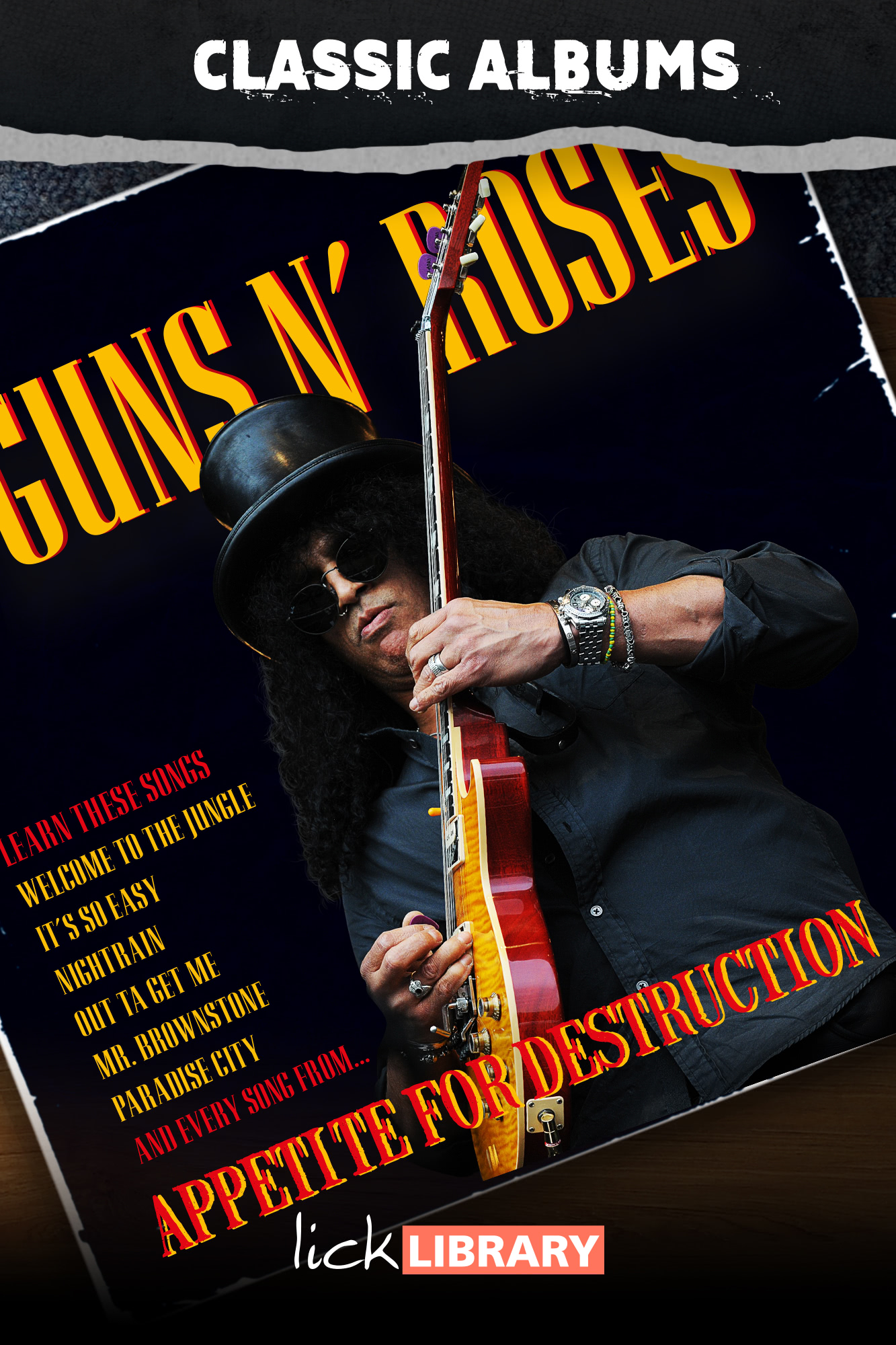
Study Appetite For Destruction with Danny Gill at Lick Library. Learn iconic riffs, solos and hard rock guitar techniques inspired by Slash.

Explore Extreme II Pornograffitti with Sam Bell at Lick Library. Learn funk rock riffs, advanced rhythms and virtuosic lead guitar techniques.

Learn to play in the style of Slash with Danny Gill at Lick Library. Explore blues rock phrasing, bends and iconic hard rock lead guitar techniques.

Study Use Your Illusion II with Danny Gill at Lick Library. Learn expressive solos, riffs and hard rock guitar techniques inspired by Slash.

Unlock Slash and Izzy Stradlin’s iconic rock guitar work in Guns N' Roses’ Use Your Illusion I with this Lick Library course—your ultimate guide to mastering classic riffs and solos.

Learn Guns N’ Roses style guitar with Danny Gill at Lick Library. Explore riffs, phrasing and hard rock lead guitar techniques inspired by Slash.

Learn Slash inspired licks with Danny Gill at Lick Library. Explore phrasing, tone and iconic hard rock lead guitar techniques.

Learn to play in the style of Guns N’ Roses with Danny Gill at Lick Library. Explore riffs, phrasing and Slash inspired techniques.

Learn Slash inspired licks with Danny Gill at Lick Library. Explore blues rock phrasing, bends and melodic solo ideas from classic hard rock.

Learn rock basslines with Phil Williams at Lick Library. Explore groove, timing and classic rock styles.

Learn Nirvana’s Nevermind with Sam Bell at Lick Library. Study raw riffs, rhythms and tone that defined alternative rock guitar history.